
Gifting Operations
End-of-Year Staff Gifts: Gift Card or Physical Gift?
Written by the Wischos Gift sourcing team

Quick Answer
Gift cards suit programmes where recipient choice and easier distribution matter most. Physical gifts work when an item has a credible daily use across the recipients' working patterns. Mixed teams can use one broad-use item, a shared set with a strong anchor, or a small number of practical formats.
By September, year-end staff gifting stops being a nice idea and starts becoming a deadline.
Budgets need approval. Recipient lists need checking. Custom artwork needs signing off. And if the gifts are going to more than one office — or more than one country — the delivery plan needs to be settled earlier than most teams expect.
Before looking at products, answer two questions:
- What is the programme meant to achieve?
- How do the recipients actually spend their working day?
Those two answers usually make the gift card versus physical gift decision much easier.
Start with the honest answer: many employees would choose a gift card
In a GroupTogether survey of 1,045 US workers, 47.9% selected a gift card as their ideal year-end workplace gift — the largest single response by a wide margin, though not a statistical majority. The remaining choices included gift baskets (17.8%) and personalised thank-you notes (15.9%). View the reported survey findings.
The result is a useful signal, not a universal rule. It reflects one workforce sample, and GroupTogether is itself a gift-card provider. Recipient preferences can change with the market, workforce and purpose of the programme.
That preference should not be dismissed. Gift cards give people choice, can remove much of the physical fulfilment work and reduce the risk of sending hundreds of employees something they neither need nor want. They are not administration-free: availability, currency, expiry terms, tax treatment and recipient-data handling can vary between programmes.
If recipient preference is the only measure of success, a gift card is difficult to beat.
But that is not always the only objective.
Once redeemed, however, a gift card usually leaves little visible reminder of the programme. A useful physical gift can remain on a desk, travel in a work bag or become part of someone's everyday routine. That allows it to support employer branding and employee recognition long after the year-end event.
The important word is useful. A branded item that ends up in a drawer does not create lasting brand presence. It creates clutter. This is consistent with PPAI's 2025 consumer research, which found usefulness was the leading reason people kept branded products, while poor material or construction was the strongest immediate rejection trigger.
A gift card is probably the better option when:
- Employees are spread across many locations or home addresses
- The workforce is so varied that no single practical physical item has a credible shared use
- The budget will not stretch to a physical gift that feels genuinely considered
- The delivery date is too close for custom production
- Giving employees a choice matters more than creating a shared physical item
A physical gift has a stronger case when:
- The programme is intended to remain visible after the year-end event
- Most recipients share a repeatable use case for the item, whether at a desk, in a work bag, in a vehicle or on site
- The item solves a small, recurring problem in the recipient's day
- Individual names can be added without making fulfilment unmanageable
- The budget supports something people will want to keep
There is no rule saying every employee must receive the same format. For a large organisation with very different working environments, splitting the programme by role can be more thoughtful than forcing one gift onto everyone.
Look at the working day, not just the job title
The most useful filter for a physical gift is simple: where will the recipient use it?

Desk-based employees
A desk gift can work well when the objects earn their place.
That might be a pen that becomes the one they use every day, a card holder that replaces a loose stack of business cards or a device stand that comes out whenever the laptop does.
Not every desk needs a five-piece set. Two well-chosen pieces are often better than a box of items included simply to make the gift look larger.
For a broader look at why some corporate gifts get used while others are quietly put away, see what makes a corporate gift worth keeping.
Employees who travel regularly
For frequent travellers, the calculation changes. Compact everyday-carry products generally make more sense than conventional desk accessories.
A slim key organiser, a durable bottle or a pen that fits comfortably in a jacket or laptop bag has a better chance of being used than an item designed to stay beside a monitor.
Field, warehouse and mobile teams
A desk set is rarely the right gift for someone whose "desk" is a vehicle, a site office or a shared workstation.
For these teams, a gift card or a practical everyday-carry item will usually land better. This is one of the most common mistakes in staff gifting: choosing from the buyer's working environment rather than the recipient's.
Mixed teams
If the workforce includes office staff, drivers, technicians and remote employees, map the working patterns before considering seniority. That does not automatically mean creating a different gift for every group.
There is a middle route between one narrowly chosen item and several separate kits: one shared set built around a broad-use anchor. A pen or bottle might carry the main value, while a small number of companion pieces suit different routines. The anchor should work for most recipients and carry most of the set's practical and perceived value. Employees do not need to use every component, but the set should not depend on most people ignoring most of what is inside it.
Companion pieces should add credible relevance without consuming the budget needed to make the anchor worth keeping. Filling a box with unrelated products in the hope that everyone finds one usable item usually spreads the budget too thinly and creates avoidable waste.
If the working environments are too far apart for one shared set, use two or three practical groups. Giving different formats for reasons employees can understand is easier to explain than creating tiers that appear to rank people by importance.
Where a metal gift set genuinely works
For a primarily desk-based team, a well-made metal set offers a few advantages over plastic, printed or short-lived promotional products.
First, engraving lasts. A name or logo laser-engraved into a metal surface will not peel away or wash off. That makes metal particularly useful when each item carries the recipient's own name.
Personalisation matters, although it should not be confused with putting a larger logo on the product. In Snappy's 2026 Workforce Study, the employee-gifting platform reported that 73% of the 1,500 full-time US employees surveyed identified personalisation as a factor that makes recognition feel genuine — ahead of thoughtfulness, public acknowledgement and timing.
The practical lesson is not that every surface should be engraved. It is that the recipient should feel the item was prepared for them.
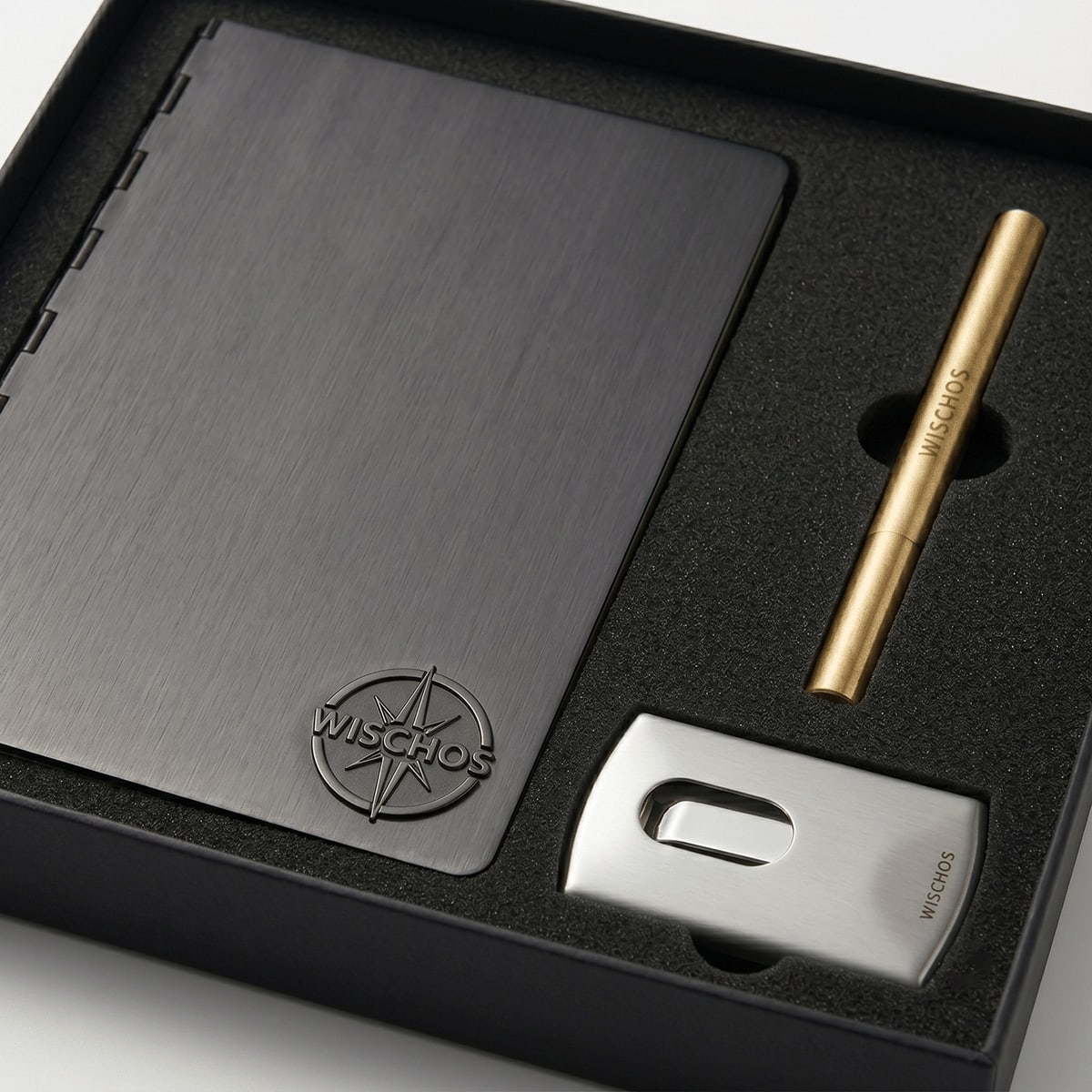
Metal also allows for restrained branding. A logo can sit on the clip of a pen, on the underside of a stand or in a small area of the packaging. When the branding is subtle, recipients are more likely to use the gift away from the office as well.
That said, metal is not automatically premium. Finish quality, tolerances, weight, usefulness and packaging matter far more than the material name on a specification sheet.
For a comparison of common metals and where each one works best, see our metals guide.
When a metal gift set is the wrong choice
There are situations where we would recommend another route.
The order is below 50 units
For the types of fully bespoke offshore projects we handle, the setup work, minimum quantities and freight can be difficult to justify at this scale.
An in-stock item with local engraving — or a locally sourced product — may cost more per unit but still produce a better overall result. Fifty units is a useful rule of thumb, not a universal cutoff; product complexity can move the number in either direction.
The delivery window is under eight weeks
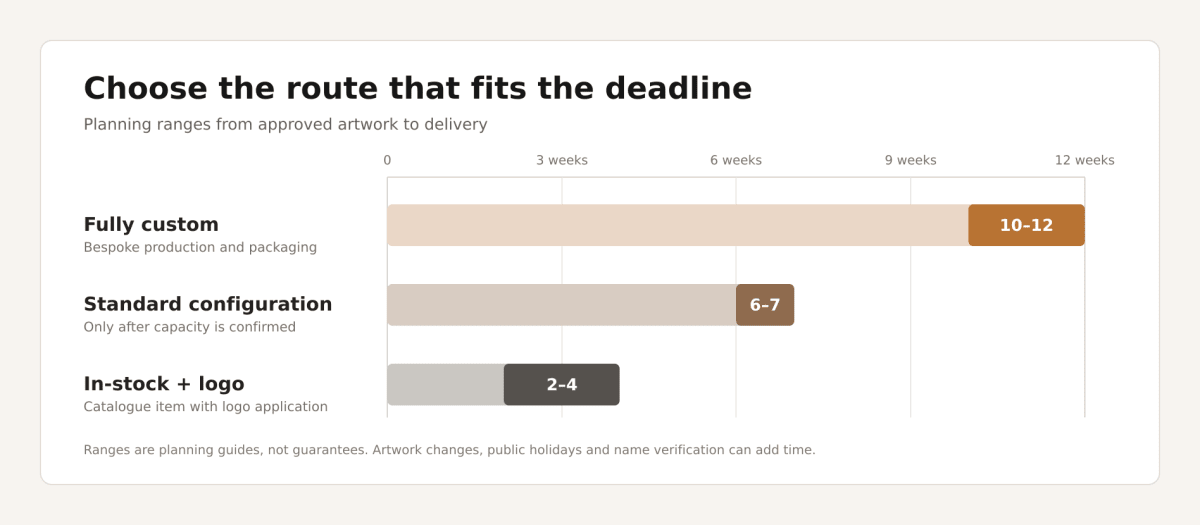
In our typical planning, a fully custom offshore project needs approximately 10–12 weeks from approved artwork to delivery.
The phrase approved artwork matters. The clock does not start with the first enquiry. Time spent finalising names, logo files, finishes and packaging comes before production begins.
Air-freight timing varies by destination, customs clearance and final-mile delivery. A standard configuration may sometimes be completed on a shorter schedule, but only when components are available, artwork is straightforward and production capacity has been confirmed in advance.
In-stock catalogue products that only require logo application are more forgiving. Depending on quantity and supplier capacity, two to four weeks is a more typical range.
These are planning ranges, not delivery guarantees. Public holidays, artwork revisions and individual-name checking can all extend the schedule.
The workforce is mainly field-based
If the recipients do not have a fixed desk, do not try to make a desk set fit the brief. Choose an item that travels with them — or give them the freedom to choose.
The budget cannot support a considered physical gift
There is no single budget threshold that works across every market. At lower per-person budgets, freight, packaging and minimum-order costs can consume too much of the available spend.
Before comparing unit prices, ask for the landed cost: product, personalisation, packaging, freight, duties and delivery to the final distribution point. A low factory price is not the same as a low programme cost.
Ordering year-end staff gifts for Q4 delivery
If you are reading this in September and need the gifts in November or December, now is the time to settle the brief.
Before contacting a supplier, confirm:
- Approximate recipient count
- The main working patterns across the recipient group
- Delivery country or countries
- Budget per person
- Whether each gift needs an individual name
- Any product-safety, testing, material, packaging or sustainability documentation the organisation requires
- The date the gifts must physically be in hand
Work backwards from the in-hand date, not the event date. If HR still needs several days to sort and distribute the gifts internally, include that time in the schedule.
Compliance requirements depend on the product category and where it will be distributed. Ask the supplier to confirm that current test reports and supporting documents apply to the exact item, material and decoration being supplied — particularly for drinkware, food-contact items and products containing batteries. A report for a similar product is not automatically evidence for the final product. PPAI's product-safety guidance explains why intended users, distribution markets and applicable testing should be established at the start of the project.
For a detailed breakdown of sampling, artwork, production, engraving and freight stages, see corporate gift lead times: a planning guide.
You can also browse our gift set configurations. If you send us the team size, budget, destination and required date, we can tell you whether a custom metal set is realistic — or whether another format would make more sense.
Frequently asked questions
Should we give employees a gift card or a physical gift?
Choose a gift card when recipient choice and easier distribution matter most, especially when no physical item has a credible shared use. Choose a physical gift when it fits the recipients' daily routines and the programme is intended to create longer-term recognition. Having a fixed desk is not a requirement; the relevant question is where and how the item will be used.
For mixed workforces, compare three routes: one broad-use item, one shared set with a useful anchor, or a small number of formats for different working patterns.
Can we add each employee's name?
Yes. You will need to supply a verified name file before engraving begins.
Check spelling, capitalisation, preferred names and special characters carefully. Agree how the name file will be transferred, who can access it and when it will be deleted after production. Changes made after artwork approval may delay production or require items to be remade.
Should everyone receive the same gift?
For a first large-scale programme, one gift or one shared set is easier to order, distribute and explain. A shared set can work when it has a broad-use anchor and useful companion pieces; employees do not need to use every component.
If working patterns are too different for one set, divide the programme for a reason recipients will understand — such as office-based versus field-based work. Tiers based purely on seniority or tenure can create comparisons that overshadow the gesture itself.
What are the tax implications of staff gifts?
Tax treatment depends on the recipient's jurisdiction, the value of the gift and how the programme is structured. Some markets provide exemptions for minor benefits below a threshold; others may treat the gift as taxable remuneration.
Confirm the position with a qualified tax adviser before approving the final budget.
Wischos Gift supports promotional distributors, agencies and corporate-gifting partners with custom metal gift-set sourcing, development and production. Where a distributor or agency is leading the programme, we work through that partner. Share the headcount, budget, delivery locations and deadline, and we will say whether a metal set is a sensible fit — or whether another route would be better. Talk to our team.
More Articles
Ready to order?
Browse the Catalogue or Send a Brief
Curated metal products and gift set concepts for B2B programs. Custom branding, packaging, and sourcing support available.