
Gifting Strategy
What Makes a Corporate Gift Worth Keeping?
Wischos Gift
Quick Answer
A gift is worth keeping when it solves a real daily problem for the recipient, feels substantial in hand, and carries branding restrained enough that the recipient would use it without the logo. Utility dominates — PPAI data shows 75.4% keep branded items because they are useful.
Most corporate gifts don't survive the first week. They get opened, appreciated for a moment, and quietly moved to a drawer — or a recycling bin — within days.
That isn't cynicism. PPAI's 2024 Consumer Study found that 75.4% of people keep a branded product specifically because it is useful — by a wide margin the dominant factor. The inverse is equally true: items that don't earn daily utility are the ones that disappear.
The question worth asking before any programme is designed isn't "what should we give?" but a more demanding one: what do people actually keep, and why?
After sourcing custom metal gift sets for corporate programmes across Australia, New Zealand, Singapore, and the UAE, the answer is consistently the same: recipients keep things that are genuinely useful, feel good in the hand, and don't look like walking advertisements.
The Desk Drawer Test
Before you order anything, run it through this mental filter: will the recipient use this at their desk or carry it on their person within 30 days — and still be doing so in 12 months?
If the honest answer is no, you've already identified the problem. Most gifts fail this test not because of poor quality, but because they solve no real problem. A mug that joins eleven others in a kitchen cabinet. A tote bag that goes into a cupboard of tote bags. A notebook that stays blank because the recipient already has a preferred system.
Gifts that pass the desk drawer test share a common trait: they replace or improve something the recipient was already doing. A precision bolt-action pen replaces the disposable pen they kept losing. A machined metal key organiser replaces a chaotic keyring. A vacuum-insulated titanium bottle replaces the plastic one they were tolerating. The gift slots into an existing behaviour rather than creating a new obligation.
Usefulness Is Not the Same as Practicality
There is a common misreading of "useful" in corporate gifting. Procurement managers often interpret it as "practical" — something basic and broadly applicable. Practical is not wrong, but it tends to produce safe, forgettable results: USB drives, generic pens, branded notebooks.
Useful in the gifting context means the item has daily friction-reduction value for the specific recipient. That requires knowing something about who they are. A desk-based executive who travels quarterly has different daily-carry needs than a field sales rep who is airport-to-airport three weeks out of four.
This is why recipient profiling matters before product selection. A curated set built around a specific recipient type — their role, their work environment, their daily tools — will almost always outperform a generic premium hamper assembled from whatever was trending that quarter.
Substance Is Felt Before It Is Seen
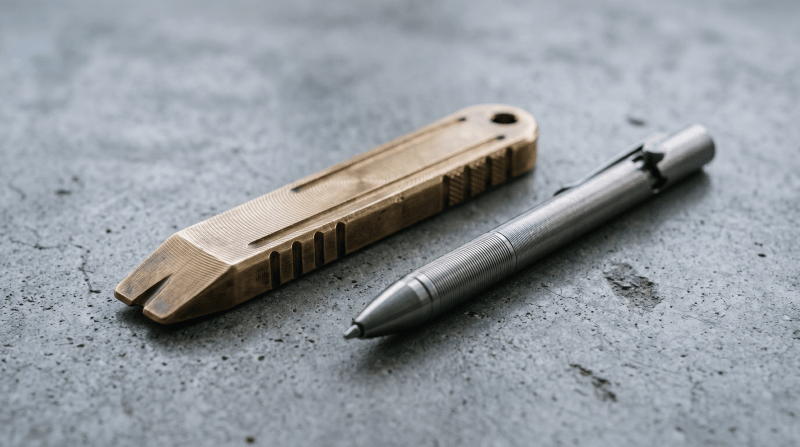
There is a moment when someone picks up a well-made metal object — a solid brass pen, a machined steel card holder — and their hand makes a judgment before their eyes do. The weight registers. The temperature of the metal. The precision of the machined thread or the click of the mechanism.
Coresight Research puts the average corporate gift spend at $78 per item, with the most common range between $75 and $100. Recipients don't know the invoice figure — but they can feel the gap. A gift that feels underweight communicates something about the relationship it was meant to strengthen.
This is why material selection is a more consequential decision than most buyers realise. Stainless steel, aluminum, brass, and titanium each read differently in the hand. A machined stainless steel daily-carry tool at $28 FOB lands entirely differently from a plastic-and-rubber equivalent at $12. The cost difference is marginal when distributed across a programme budget. The perceived difference is substantial.
Branding — Less Than You Think, More Than Nothing
The most effective branding strategy for a gift that gets kept is restrained: a logo engraved on the clip of a pen, a small mark on the base of a desk accessory, an embossed mark on a packaging insert. Permanent, present, but not dominating the object.
Recipients are far more likely to carry or display an object that doesn't feel like a walking advertisement. A heavily branded item signals that it was given to serve the company's interests, not theirs. Restraint in branding signals the opposite: that the gift was chosen to be used.
Laser engraving on metal works best here. It becomes part of the material rather than sitting on top of it. Five years of daily use doesn't fade it. That longevity matters: PPAI research shows branded drinkware generates more than 1,400 impressions over its lifetime — a figure that only holds if the item remains in active use long enough to accumulate them.
The Coherence Factor
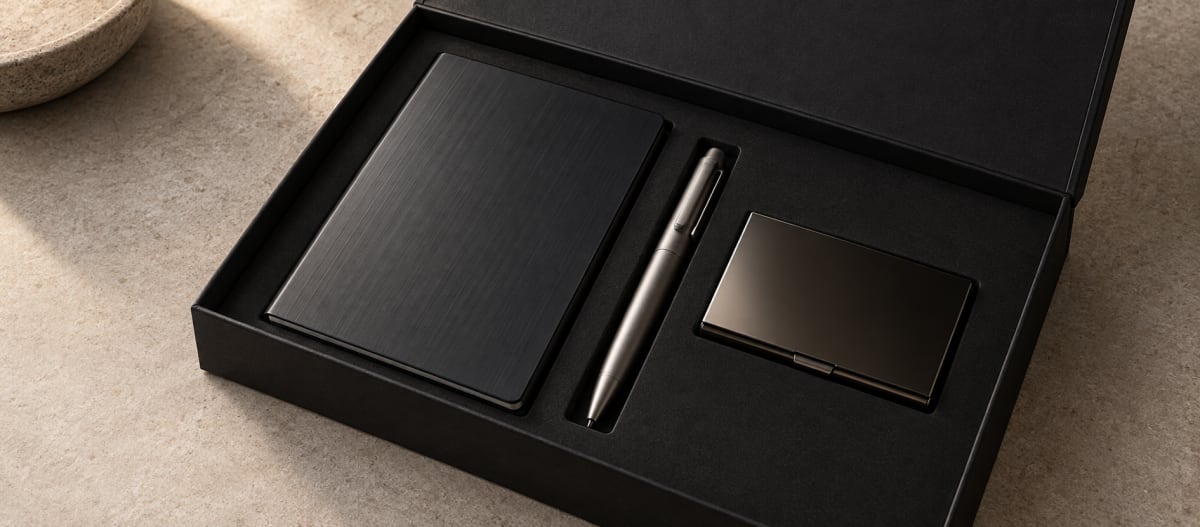
Individual products matter less than the overall impression of the gift. A curated set of three or four objects that share a design language — similar finishes, complementary scales, a consistent colour family — reads as considered. A collection of unrelated branded items, regardless of individual quality, reads as assembled rather than curated.
This is one of the underappreciated advantages of working with a specialist rather than pulling from a catalogue. Anyone can source a stainless steel pen. Fewer suppliers can source a pen, a desk tray, a key organiser, and a flask that look like they belong together — and deliver them in unified packaging that doesn't betray the budget.
The packaging itself extends the coherence. A rigid lid box with magnetic closure and a custom foam insert signals that the same level of care applied to the box applies to what's inside. Conversely, a premium pen shipped in a generic polybag undoes most of the impression the product itself would have made.
One Premium Gift Over Five Cheap Ones
If there is a single operational principle that guides every recommendation we give, it's this: one gift that earns its place in daily use is worth more than five that don't.
Corporate gifting programmes routinely spread budget across volume — more recipients, lower per-unit spend, safer choices. The result is a programme that reaches more people with less impact. Narrowing the recipient list and concentrating the per-unit spend on something genuinely worth keeping typically produces better relationship outcomes and better brand recall.
Sendoso's research, drawn from a dataset of over 390 million outbound emails, found that gifting increased meeting rates by 3.08× and win rates by 1.84×. The mechanism is consistent with what field experience shows: a gift that stays in someone's workspace creates brand presence at the moments when decisions are made. That is something a well-timed email cannot replicate.
The Practical Checklist
Before finalising any corporate gift order, run through these five questions:
- Does this solve a real daily problem for this specific recipient? If not, rethink the product.
- Does the material communicate substance? Weight, finish, and construction are perceived before features.
- Is the branding restrained enough that the recipient would use it without us? If no, the logo is too prominent.
- Do the items in the set share a coherent design language? Curated reads differently than assembled.
- Does the packaging reflect the same quality as the product? First impressions set the baseline.
A gift that passes all five is worth keeping. That's the only metric that matters.
Frequently Asked Questions
What is the desk drawer test for corporate gifts?
The desk drawer test is a simple filter: will the recipient use this at their desk or carry it on their person within 30 days — and still be doing so in 12 months? If the honest answer is no, the gift is likely to disappear. Gifts that pass solve a problem the recipient was already experiencing.
How prominent should branding be on a corporate gift?
Restrained. A small engraved logo on a pen clip, a discreet mark on a base, or an embossed element on packaging. Recipients are more likely to carry or display an object that doesn't look like a walking advertisement. Heavy branding signals the gift serves the company's interests; restraint signals it was chosen for the recipient.
Is it better to give one premium gift or several cheaper items?
One premium item that earns daily use consistently outperforms five that don't. Spreading budget across volume reduces per-item impact. Concentrating per-unit spend on something genuinely worth keeping typically produces better relationship outcomes and better brand recall over time.
Wischos Gift sources and curates custom metal corporate gift sets for procurement and brand managers in Australia, New Zealand, Singapore, the UAE, and other primary destinations. If you're planning a programme and want a recommendation based on your recipient profile and timeline, get in touch.
More Articles

Ready to order?
Browse the Catalogue or Send a Brief
Curated metal products and gift set concepts for B2B programs. Custom branding, packaging, and sourcing support available.